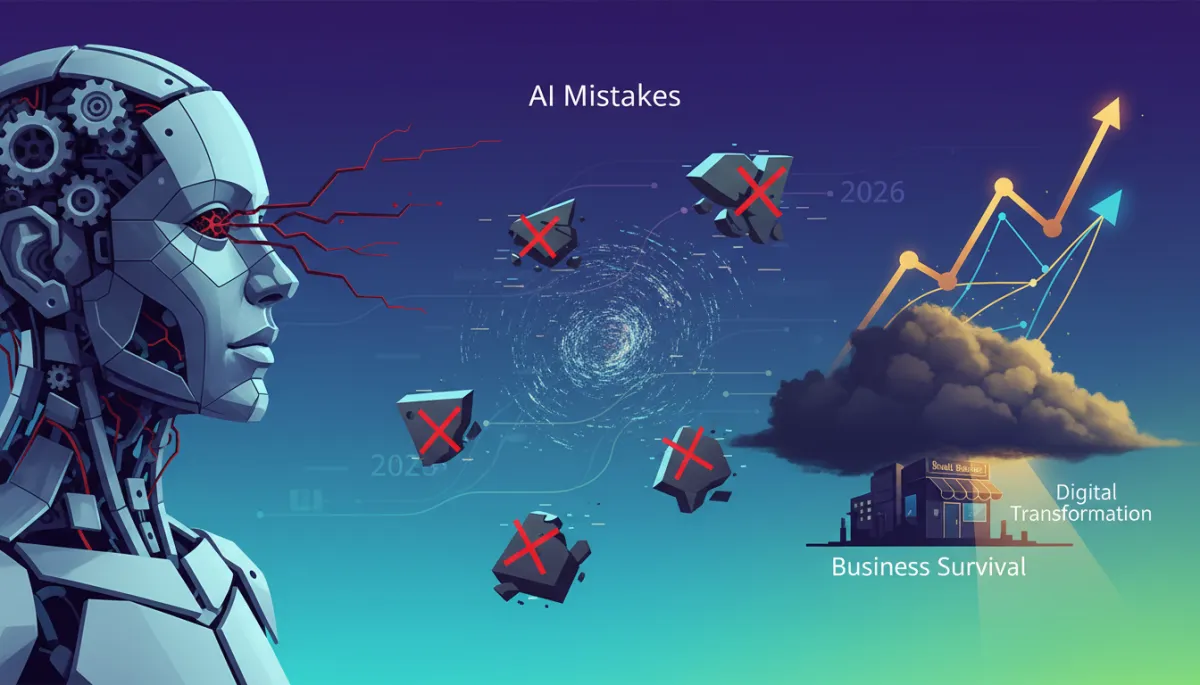
5 AI Mistakes Killing Small Businesses in 2026
AI Mistakes, Small Business Struggles, 2026 Business Trends
5 AI Mistakes That Are Quietly Killing Small Businesses in 2026
I’m Marvin, and I’m going to be blunt: in 2026, AI will not politely tap your shoulder if you misuse it. It will quietly drain your time, money, and customer trust while you tell yourself you’re “doing digital transformation.” Let’s talk about the AI mistakes that are slowly strangling local businesses—and how you can stop the damage before it’s permanent.
The 2026 Reality: AI Can Save You—or Slowly Sink You
In 2026, AI is baked into almost everything: your POS system, your email platform, your ads manager, even the phone in your pocket. Big brands are using autonomous AI agents, generative copilots, and real-time analytics to move faster than ever. According to recent AI business trends, roughly 20% of companies are already scooping up about 75% of AI’s financial gains by using it strategically—not just as a shiny toy.
Meanwhile, a lot of local businesses are stuck in a dangerous middle ground: they’ve adopted AI tools, but without a plan. That’s where the real AI Mistakes live—quiet, subtle, and expensive. Let’s walk through the five deadliest ones I see in small business struggles every week, and I’ll give you practical business survival tips to fix each one.
Mistake #1: Treating AI Like a Magic Intern You Never Supervise
Let’s start with the laziest fantasy of 2026: “I’ll plug in this AI tool, it’ll handle everything, and I’ll finally get my weekends back.” No, you won’t. Not like that. When you over-rely on AI without human oversight, you don’t get freedom—you get quiet chaos. Forbes has already warned that small businesses that blindly trust AI, without understanding its limits, end up with bad decisions, wrong insights, and awkward customer moments they never see coming until reviews tank.
Witty warning: If your plan is “Let the bot handle it,” you don’t have a plan. You have a liability with a login screen.
How This Quietly Kills Your Business
AI writes generic, off-brand emails that feel spammy, so open rates drop and unsubscribes climb—but you only notice when revenue slips months later.
Chatbots confidently give wrong answers, misquote policies, or promise things your team can’t deliver, quietly eroding trust with loyal customers.
AI-generated reports look impressive, but you never verify the assumptions, so you make decisions based on pretty nonsense.
The Fix: Make AI a Copilot, Not the Pilot
Here’s the direct truth: AI is brilliant at generating options and doing grunt work fast. It is terrible at understanding your values, your local context, and the subtle things your regulars love about you. That’s your job. So use AI as a copilot:
Have AI draft emails, replies, or posts—but you or a trusted staff member edits for tone, accuracy, and fit for your brand before anything goes live.
Set “guardrails” in your tools: limit what chatbots can promise, and add clear routes to a human when questions get complex or emotional.
Review AI-generated analytics with a skeptical eye. Ask, “Does this match what we’re actually seeing on the ground?”
💡 Survival Tip: If no human is accountable for checking an AI output before customers see it, you’re not using AI—you’re gambling with your reputation.
Mistake #2: Overautomating and Accidentally Deleting Your Human Touch
In the race to “keep up with 2026 business trends,” many small businesses have done something tragic: they automated away the very thing that made them special. AI phone trees, auto-replies, AI-only support, AI-driven recommendations—everything is efficient, and nothing feels human anymore. Customers might as well be talking to a vending machine with better grammar.
Witty warning: If your customers have to solve a puzzle to reach a real person, they won’t. They’ll just call your competitor instead.
How This Quietly Kills Your Business
Loyal customers feel ignored when they get canned AI responses to nuanced questions, so they stop bothering and quietly drift away.
Negative reviews mention “no real person,” “couldn’t get help,” and “felt like talking to a robot”—and that’s a red flag to new customers.
Your team loses touch with real customer pain points because the bots intercept everything, so your offers slowly become irrelevant.
The Fix: Automate the Boring, Humanize the Important
AI should remove friction, not relationships. The smartest digital transformation strategy for small businesses in 2026 is simple: let AI handle the repetitive tasks so your people can double down on the human stuff. For example:
Use AI for appointment reminders, basic FAQs, and order status checks—but always offer a clear, fast path to a real person for anything more complex.
Let AI summarize customer conversations for your staff so they can jump in already informed, not replace the staff entirely.
Have humans personally respond to complaints, special requests, and high-value customers. That’s where loyalty is built—and where AI still falls short.

The winning combo in 2026 is simple: AI in the back, humans in the front.
Mistake #3: Ignoring Data Privacy and Hoping Regulators Are Too Busy
As more of your business runs on cloud tools, AI platforms, and online forms, you’re sitting on a growing pile of customer data. In 2026, that pile is not just an asset—it’s a legal and ethical minefield. Many small businesses are still copying emails into random tools, sharing logins, or letting AI apps access customer data they don’t fully understand. That’s not “being scrappy.” That’s inviting trouble.
Witty warning: “We’re just a small business, no one will care” is not a defense. It’s a confession you make before the fine arrives.
How This Quietly Kills Your Business
Customers lose trust if they sense their data is being misused or shared without consent—especially after so many high-profile breaches in recent years.
New privacy regulations don’t care that you’re small; non-compliance can mean serious fines and forced changes you can’t afford.
A single breach or leak—sometimes caused by a sloppy AI integration—can undo years of goodwill in a week.
The Fix: Treat Customer Data Like Cash, Not Confetti
Business news outlets have been clear: data privacy and security are top digital transformation challenges for small businesses. You don’t need a full-time legal team, but you do need discipline. Start here:
Audit your tools: list every AI and digital platform that touches customer data. If you don’t know what a tool does with that data, find out or stop using it.
Turn on basic security: unique logins, two-factor authentication, and role-based access so not everyone can see everything.
Be transparent: tell customers, in plain language, what you collect, why, and how you protect it. Transparency builds trust—and trust builds sales.
💡 Survival Tip: Before you connect any AI tool to your customer list, ask: “If this got hacked tomorrow, what would I regret exposing?” Then act accordingly.
Mistake #4: Buying Fancy AI Tools Without a Simple Strategy
AI vendors are very good at selling hope. They promise more leads, smoother operations, and dashboards that practically glow with insight. The problem? Many small businesses sign up for three or four different AI-powered platforms, never integrate them, barely use them, and then complain that “AI doesn’t work for us.” In reality, the tools are fine. The strategy is missing in action.
Witty warning: If your “AI stack” is just a graveyard of unused subscriptions, you’re not transforming—you’re donating.
How This Quietly Kills Your Business
You bleed cash on monthly fees for tools no one really knows how to use, adding financial pressure without any return.
Your team gets overwhelmed by too many dashboards and logins, so they give up and go back to manual workarounds anyway.
Disconnected systems mean your data is scattered; you can’t get a clear picture of what’s working, so decisions stay gut-based instead of data-driven.
The Fix: Start With One Painful Problem, Not Ten Shiny Tools
The smartest 2026 business trends aren’t about stacking more tech; they’re about orchestrating a few tools well. Before you buy anything else, answer one question: What is the single most expensive or painful process in my business right now? That’s your starting point for AI solutions. Then:
Pick one AI tool that directly targets that problem—booking, invoicing, follow-ups, inventory, whatever—and commit to actually implementing it fully for 60–90 days.
Make one person the “owner” of that tool. Their job is to learn it, train others, and report results in plain numbers: hours saved, errors reduced, revenue gained.
Only after you see clear value do you consider adding the next AI capability—and even then, you check how well it integrates with what you already use.
💡 Survival Tip: One well-used AI tool beats five forgotten ones. Measure success in fewer late nights, fewer mistakes, and more repeat business—not in how futuristic your software stack sounds.
Mistake #5: Skipping AI Training and Expecting Your Team to “Figure It Out”
Here’s the quietest killer of them all: you roll out new AI-powered tools, send one email about it, maybe show a quick demo, and then assume your team will adapt. They don’t. They click around, get confused, and eventually go back to the old way because “it’s faster.” Meanwhile, you’re paying for tech that no one is really using—and resenting your staff for not “embracing innovation.”
Witty warning: “We bought the software” is not the same as “We changed how we work.” That missing middle is called training.
How This Quietly Kills Your Business
Your team feels threatened or frustrated by AI instead of supported by it, which hurts morale and productivity.
Tools are used at 10–20% of their potential, so you never see the time savings or insights they’re capable of delivering.
You miss out on the biggest 2026 business trend of all: teams that know how to work with AI, not against it, are pulling ahead fast.
The Fix: Train Your People Like They’re the Main Asset—Because They Are
Big companies are investing heavily in ongoing AI skills development. You don’t need a corporate training department, but you do need a plan. Think simple, practical, and consistent:
Run short, focused training sessions—30–45 minutes—on how AI tools help with specific tasks your team actually does: scheduling, responding to inquiries, tracking orders, marketing emails.
Create simple cheat sheets: what the tool is for, what to use it for daily, and what to never let it decide on its own (like discounts, refunds, or sensitive messages).
Celebrate wins: when AI helps a team member save time or rescue a customer issue, talk about it. Make AI feel like a helpful teammate, not a looming replacement.
💡 Survival Tip: Your competitive edge isn’t “having AI.” It’s having a team that knows how to use it confidently, ethically, and creatively.
Pulling It Together: A Simple AI Game Plan for Local Businesses
Let’s be direct. AI isn’t going away. The businesses that survive and grow through 2026 and beyond won’t be the ones with the most tools—they’ll be the ones who avoid these quiet killers and use AI with intention. If you’re feeling behind or burned by past AI mistakes, here’s a straightforward reset:
Audit your AI. List every AI-powered tool you use. Note what it’s supposed to do, what it actually does, and whether it touches customer data.
Kill what’s not working. If a tool isn’t saving time, improving accuracy, or driving revenue—and no one owns it—either assign an owner or cancel it.
Protect your data. Tighten access, clarify your privacy policy, and only connect AI tools you trust and understand.
Re-humanize your customer journey. Walk through your website, phone system, and messaging as if you were a new customer. Where do you hit robots instead of people? Fix that balance.
Invest in skills, not just software. Give your team time and training to understand AI tools, and make it clear that AI is there to support them, not replace them.
The truth is, AI can absolutely help with the classic small business struggles: thin margins, limited staff, rising expectations, and constant competition. It can give you better insights, faster operations, and more consistent marketing. But only if you use it deliberately, with guardrails, and with your human strengths front and center.
Final Word from Marvin: Don’t Fear AI—Fear Using It Badly
I’ll leave you with this: AI is not your enemy, and it’s not your savior. It’s a power tool. In the right hands, with the right plan, it helps you build a stronger, smarter business that can survive the next wave of 2026 business trends. In the wrong hands—or worse, in unattended hands—it quietly cuts into the foundation you’ve spent years building.
If you recognize yourself in any of these five AI mistakes, don’t panic. Pick one area, fix it this month, and move on to the next. That’s how real digital transformation happens in small businesses: not with grand speeches, but with clear decisions, better habits, and tools that finally earn their keep.
Use AI to amplify what already makes your local business worth choosing: your service, your integrity, your understanding of your community. Do that, and AI stops being a quiet killer and becomes exactly what you need it to be in 2026—your sharpest ally in staying alive and staying ahead.