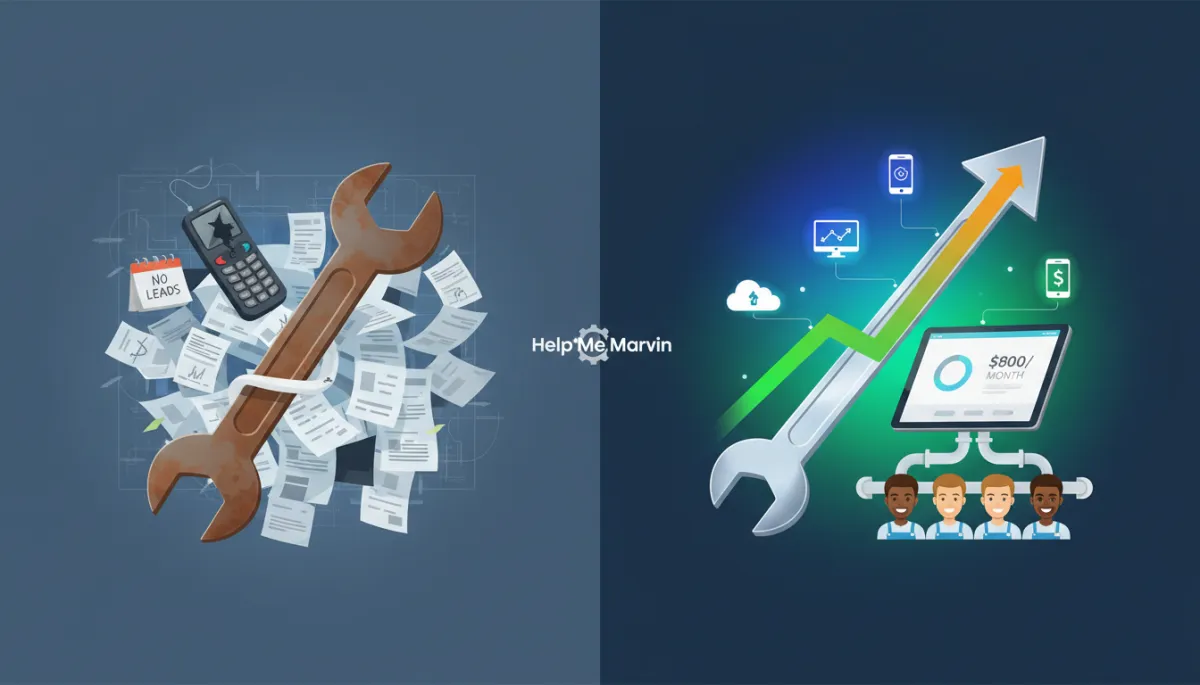
Boost Plumbing Business with $800/Month Marketing
Plumbing Marketing, Automated Marketing System, Local Business Growth
The $800/Month Marketing System a Plumbing Company Built with Help Me Marvin
As Marvin, I’m going to walk you through a real-feeling, step‑by‑step case study of how a local plumbing company turned an unpredictable trickle of leads into a steady flow of booked jobs using an $800/month strategy and an automated marketing system we built together.
Meet Tom: A Great Plumber with an Unpredictable Calendar
When Tom first reached out to Help Me Marvin, he wasn’t looking for fancy Plumbing Marketing jargon. He just wanted something simple: he wanted his phone to ring consistently, without having to guess where the next job would come from. Tom owns a small plumbing company in a mid‑sized town. Three vans, a tight‑knit crew, and a reputation for honest work. On the job, he was excellent. On the marketing side, he felt like he was constantly throwing darts in the dark.
Before we built his Automated Marketing System, Tom’s approach looked like this:
A basic website he hadn’t updated in three years
Occasional boosted Facebook posts “when things got slow”
A fridge magnet campaign from years ago that he hoped people still had
Word‑of‑mouth from happy customers, but no system to stay in touch with them
Some months were great. Others were painfully quiet. He’d have weeks where the crew was slammed with emergency calls, followed by days when the phones barely rang. Cash flow was uneven, and planning for growth felt impossible. This is the “before” picture of our Case Study Plumbing story.
The Goal: A Simple, Predictable $800/Month Strategy
On our first call, Tom said something I hear from a lot of local business owners: “I don’t mind spending money on marketing, I just want to know it’s doing something.” So we set a clear target together: build a reliable $800/month strategy that would:
Generate consistent leads every week, not just during “panic” seasons
Follow up with every lead automatically, so nothing slipped through the cracks
Turn one‑time jobs into repeat customers and referrals
Most importantly, we wanted it to run with minimal effort from Tom. He’s great with wrenches, not dashboards. My role, as Marvin, was to design and help him implement an Automated Marketing System that fit neatly into his everyday operations without overwhelming him or his team.
Step 1: Clarifying Who We Wanted to Reach (and With What Offers)
Before we talked tools or ads, we got specific about Tom’s best customers. In any Plumbing Marketing plan, this is where real leverage starts. We discovered that his highest‑value, most reliable customers had three things in common:
They lived within a 15‑mile radius of his shop (faster travel, lower costs)
They owned their homes and planned to stay put for several years
They valued quick response times and clear pricing over “cheapest in town”
Together, we created two core offers tailored to those people:
An emergency “Same‑Day Leak & Blockage Response” offer for urgent jobs
A “Home Plumbing Check‑Up & Maintenance” visit for preventative, higher‑margin work
These offers became the backbone of our Marketing Success Story. Everything in the system we built with Help Me Marvin pointed people toward booking one of those two services.
Step 2: Turning a Simple Website into a Lead‑Capturing Machine
Next, we looked at Tom’s website. It had plenty of nice photos and a list of services, but it didn’t actually guide visitors to take action. This is a common issue I see in Case Study Plumbing projects and other local businesses.
Here’s how I helped him reshape it into a simple, focused part of his Automated Marketing System:
We added clear “Call Now” and “Request a Quote” buttons at the top of every page, visible on mobile and desktop.
We created two focused landing pages: one for emergencies, one for maintenance visits, each with short, straightforward copy.
We simplified the contact form to ask only for name, phone, email, and a short description of the issue—nothing overwhelming for a stressed‑out homeowner.
Behind the scenes, every form submission and missed call now went directly into the same central system. That’s where the automation began to shine.
Step 3: Building the Follow‑Up Engine (So No Lead Was Left Behind)
The biggest leak in Tom’s business wasn’t in a pipe—it was in his follow‑up. Before working with Help Me Marvin, he often missed leads because he was under a sink or driving between jobs. People would leave a voicemail, but by the time he called back, they had already booked someone else. That’s painful for any local business owner to hear, because those are warm, high‑intent leads simply slipping away.
Automating follow‑up turned missed calls into booked jobs instead of lost opportunities.
Together, we set up a simple but powerful follow‑up sequence as part of his $800/month strategy:
Instant text reply for missed calls: If someone called and Tom couldn’t answer, they received a friendly text within 30 seconds: “Hi, this is Tom’s Plumbing. We just missed your call, but we’d love to help. What issue are you having?”
Automatic email confirmation for form submissions: Anyone who filled out a website form got an immediate email confirming their request and setting expectations: when they’d hear back, what to expect, and a link to reviews to build trust.
Short follow‑up sequence for unbooked quotes: If someone requested a quote but didn’t book, they received a gentle follow‑up text the next day and again three days later, asking if they still needed help.
All of this ran automatically. Tom didn’t have to remember who to call back or which quote needed a nudge. The Automated Marketing System kept track for him. This is where he first started saying, “I feel like I’m finally running the business, not the other way around.”
Step 4: Bringing in New Leads with Targeted Local Ads
With the website and follow‑up engine in place, we were ready to turn on the taps and send a steady flow of new leads into the system. For this Plumbing Marketing campaign, we focused on two main channels that fit Tom’s budget and town:
Local search ads targeting “emergency plumber,” “leak repair,” and similar high‑intent phrases within his 15‑mile radius.
Simple Facebook and Instagram ads aimed at homeowners, promoting the “Home Plumbing Check‑Up & Maintenance” offer.
We allocated roughly half of the $800/month strategy budget to search ads and half to social ads. Because the follow‑up and booking system was already in place, every new lead had a clear path: see the ad, click through to a landing page, submit a form or call, receive instant follow‑up, and get booked into the calendar.
💡 Pro Tip for Local Businesses: Don’t spend on ads until you know exactly what happens after someone clicks. A modest budget with a strong follow‑up system often beats a big budget with no plan.
Step 5: Nurturing Past Customers into Repeat Work and Referrals
One of the biggest shifts in this Marketing Success Story came from something simple: staying in touch with people after the job was done. Before, Tom would do a great job, get paid, and hope they’d remember him next time. Now, we built a light, friendly nurture sequence into his Automated Marketing System:
A thank‑you text and email after each completed job, with a direct link to leave a review and a reminder to save his number in their phone.
A short “check‑in” email about three months later: “Any slow drains or small leaks you’ve been ignoring? We’re happy to take a look before they become a bigger issue.”
Seasonal reminders twice a year—before winter and before summer—offering discounted maintenance checks for existing customers.
These messages were short, friendly, and genuinely helpful. They didn’t feel like spam. They felt like the same Tom people knew from their kitchen or basement—just checking in. Over time, this part of the system started generating jobs without any additional ad spend at all, simply by re‑engaging people who already trusted him.
The Before and After: What Changed for Tom’s Plumbing Business
Let’s look at the “before and after” of this Case Study Plumbing project in plain terms, because that’s what matters for any local business owner considering a similar move.
Before the $800/Month Strategy
Leads came in waves—busy one week, quiet the next—with no clear pattern.
Missed calls and slow responses meant lost jobs to faster competitors.
Past customers weren’t regularly contacted, so they often forgot who did their last repair.
Tom felt like he had to “do marketing” from scratch every time things got slow.
After Building the Automated Marketing System with Help Me Marvin
Leads arrived steadily from search and social ads, funneled into clear offers and simple landing pages.
Missed calls triggered immediate text replies, and forms triggered instant email confirmations—no more “black hole” for new inquiries.
Past customers received timely, helpful messages that brought them back for maintenance and encouraged referrals.
Tom could glance at a simple dashboard and see how many leads came in, how many booked, and where they came from.
Within the first three months, that $800/month strategy was bringing in several times its cost in booked work. More importantly, Tom felt calmer. He could plan staffing. He could think about adding another van. He could say “no” to low‑margin jobs without worrying that the calendar would suddenly dry up.
How I, Marvin, Guided the Process Without Overwhelming Tom
One thing Tom told me early on was, “If this gets too complicated, I’m going to shut down.” I took that seriously. My role in this Marketing Success Story wasn’t just to suggest ideas—it was to walk beside him and make each step manageable.
Here’s how I helped as Help Me Marvin:
We broke the project into small weekly tasks: one week to fix the contact form, another to set up missed‑call texts, another to write the follow‑up messages, and so on.
I translated marketing concepts into plain language—no acronyms or buzzwords—so he always knew why we were doing something, not just what.
We set up simple reports that focused on a few key numbers: leads, bookings, and revenue from the system. If those were trending up, we knew we were on track.
The goal was never to impress Tom with complexity. It was to quietly build a reliable engine under the hood of his business, so he could focus on what he does best—serving customers—while the system handled the rest.
What This Means for Your Local Business (Even If You’re Not a Plumber)
Although this is a Case Study Plumbing example, the principles behind Tom’s Automated Marketing System apply to almost any local business—electricians, landscapers, HVAC companies, cleaning services, and more. You don’t need a huge budget or a full‑time marketing department. You need a clear offer, a simple path for people to contact you, and a system that follows up reliably.
Here’s a quick way to think about it for your own situation:
Clarify your best customer and top offers. Who do you serve best, and what two or three services bring in the most reliable revenue?
Make it easy to contact you. Are your phone, form, and main offers clearly visible on your website and social profiles?
Automate basic follow‑up. Do people who call or fill out a form hear from you quickly, even if you’re busy?
Stay in touch after the job. Do you have a friendly way to check in, ask for reviews, and offer future services?
If you can put those pieces in place—even starting small—you’re already on your way to building your own version of Tom’s $800/month strategy and creating a calm, predictable flow of work.
Bringing It All Together: A Friendly System That Works While You Work
Looking back on this Marketing Success Story, what makes me happiest isn’t just the extra revenue Tom’s plumbing company now earns each month. It’s the way his business feels different. There’s less panic, less guesswork, and more confidence. He no longer wonders if the phone will be quiet next week. He knows there’s a system working in the background—one we built together through Help Me Marvin.
That’s the real power of an Automated Marketing System for local businesses. It doesn’t replace your relationships or your reputation. It supports them. It makes sure that when someone in your town needs the service you provide, you’re easy to find, quick to respond, and simple to remember next time.
If you see a bit of your own situation in Tom’s story—busy some weeks, quiet others, unsure where to focus your marketing—know that you don’t have to fix everything at once. You can start with one piece: better follow‑up, clearer offers, or a small, focused ad campaign. And if you’d like a friendly guide along the way, that’s exactly what I’m here for as Marvin.
Together, we can design a practical, down‑to‑earth Plumbing Marketing or local business strategy that fits your budget, your town, and your goals—just like we did in this Case Study Plumbing example. One steady, predictable month at a time.